
Manalapan NJ Pool Leak Case Study: Misleading Spa Symptoms and a Broken Skimmer Line
Case Summary:A homeowner in Manalapan, NJ contacted APLD because their gunite pool with an attached spa was losing approximately one inch of water per day. Before our visit, we worked with the homeowner through preliminary testing that appeared to point toward the spa. However, our onsite testing found no leak in the spa itself. The spa was not the source of the pool’s continuing water loss.
This case required us to separate two different problems within the same pool/spa system: water flowing backward through valve assemblies that were not sealing properly and a separate broken shallow-skimmer line beneath the concrete pool deck.
After confirming the leaking skimmer line and pinpointing the underground break, we temporarily isolated the failed line to stop the water loss. A couple of weeks later, we returned to the location we had marked, exposed the damaged pipe and completed the permanent repair.
The Problem: A Pool and Spa Losing Water
The Manalapan homeowner reported that the pool was losing approximately one inch of water each day. Before our visit, we worked with the homeowner through preliminary testing that included isolating the spa from the pool. When the spa water level dropped during that testing, it appeared that the spa itself might be responsible for the reported water loss.
That was a reasonable conclusion based on the symptoms, but a dropping spa level does not automatically mean the spa itself is leaking. In an attached pool/spa system, water can flow backward from the spa into the pool through shared plumbing when a valve or valve assembly does not seal properly.
The First Finding: The Spa Was Not Leaking
We tested the spa and found no leak in the spa itself. Because the reported water-level change still pointed toward the spa, we considered how the spa water level could be dropping even though the spa was not leaking.
We suspected that the valve assemblies controlling the spa jets and spa drain were not sealing properly. This could allow water from the spa to flow backward into the pool, making it appear that the spa was leaking.
We recommended that the homeowner replace those valve assemblies. Within 24 hours of the replacement, the spa held its water level. This confirmed that the original drop in the spa level had been caused by water flowing backward through the valves.
But the pool continued to lose water.
Why the First Answer Did Not Explain the Entire Problem
Replacing the valve assemblies resolved the issue of the water level dropping in the spa, but it did not stop the pool’s actual water loss. That distinction was critical. A pool can have more than one problem at the same time and identifying one issue does not prove that every source of water loss has been found.
With the spa issue resolved but the pool still losing water, we continued testing to identify the separate source of the pool leak.
The Actual Pool Leak: A Broken Shallow-Skimmer Line
Our continued testing identified a leak in the shallow-skimmer line. We then narrowed the underground break to a specific area beneath the concrete pool deck, near the edge of the patio.
Confirming that a plumbing line is leaking and pinpointing where it is broken are two separate steps. A failed pressure test identifies the leaking line. Pinpointing narrows the location of the break so a targeted repair can be made instead of opening large or random sections of the patio.
Without that additional locating work, a homeowner may be told to replace an entire plumbing line or begin digging without knowing precisely where the damaged section is located. This approach can be significantly more expensive and much more invasive than limiting the patio opening to the area where the break has been pinpointed.
Temporary Isolation Confirmed the Diagnosis
We plugged the failed skimmer line and temporarily shut down that skimmer. After the line was isolated, the pool stopped losing water. This confirmed that the broken shallow-skimmer line was the source of the pool’s continuing water loss.
The temporary isolation prevented additional water loss while the permanent underground repair was scheduled.
The Permanent Repair: The Break Was Where We Marked It
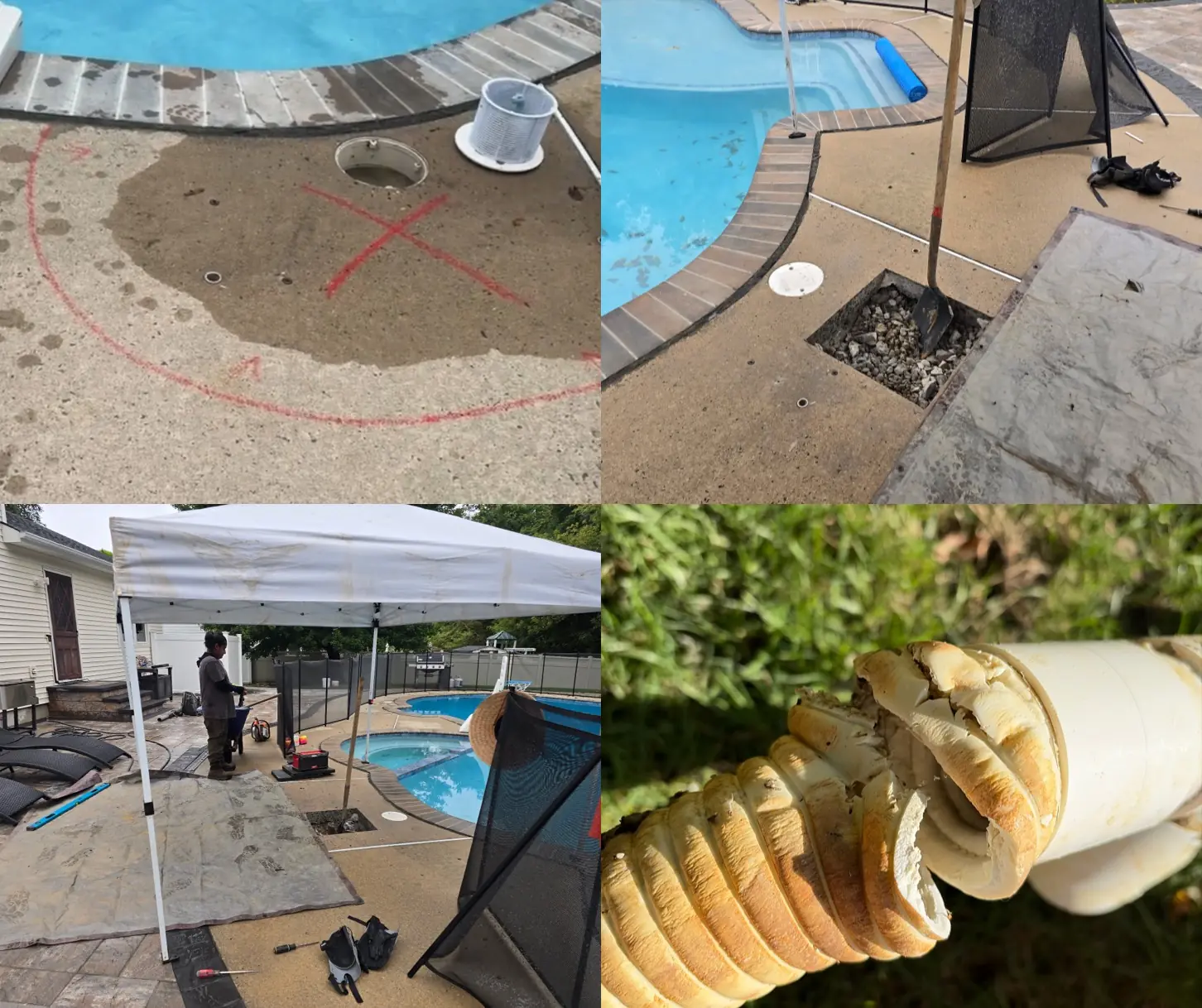
We returned to the Manalapan property and opened the area we had pinpointed along the concrete pool deck. The damaged shallow-skimmer pipe was found exactly where we had marked it.
The collage below documents the pinpointed location, targeted patio opening, repair setup and exposed pipe damage. We removed the failed section, repaired the underground plumbing and pressure tested the line to confirm that the repair was holding. We then removed the temporary plug and turned the shallow-end skimmer back on.
The Result
This Manalapan pool had two separate issues that created overlapping symptoms:
- Valve assemblies that were not sealing properly allowed water to move backward from the spa into the pool.
- A broken shallow-skimmer line caused the pool’s continued water loss.
The homeowner replaced the valve assemblies, which allowed the spa to hold its water level. We identified and pinpointed the broken skimmer line, temporarily plugged it to stop the water loss and later repaired the pipe exactly where the break had been marked.
After the repair, the skimmer line held pressure, the temporary plug was removed and the shallow-end skimmer was turned back on. Because the break had been pinpointed beforehand, the repair was completed without opening multiple sections of the concrete pool deck.
What This Manalapan Case Shows
- A dropping spa level does not automatically mean the spa itself is leaking.
- Pool/spa valve problems can make it appear that the spa is leaking when water is actually flowing backwards from the spa into the pool through the shared plumbing.
- A pool can have more than one problem at the same time.
- Correcting one issue does not prove that all water loss has been resolved.
- Pressure testing can confirm which plumbing line is leaking, while underground pinpointing narrows the location of the break.
- Pinpointing an underground break can reduce unnecessary digging beneath a pool deck.
Why Complete Pool Leak Detection Matters
This case would have been easy to misread. The spa appeared to be losing water, and there was a legitimate valve-related problem. But finding something wrong is not the same as identifying the source of water loss. Stopping after the valve issue was corrected would not have solved the pool leak.
Complete pool leak detection means continuing the testing until the confirmed findings explain what the pool and spa are doing. Depending on the symptoms, that may involve evaluating the pool and spa separately, checking the pool structure, testing individual plumbing lines and pinpointing an underground pipe break.
Learn more about pool plumbing pressure testing and underground pool plumbing leaks.
Need Pool Leak Detection in Manalapan, NJ?
APLD provides professional swimming pool leak detection throughout Manalapan and Monmouth County. We test in-ground gunite, vinyl liner and fiberglass pools, including pools with attached spas and multiple plumbing systems.
Contact APLD or call 732-333-3304 to request an appointment in Manalapan, NJ.
You can also learn more about our Manalapan pool leak detection services, view our Monmouth County service area, or review additional pool leak case studies.
Frequently Asked Questions
Why would an attached spa lose water into the pool?
If a valve or valve assembly in a connected pool/spa system does not seal properly, water may move backward from the spa into the pool. A dropping spa level can have other causes, so the system should be evaluated before assuming the spa itself is leaking.
Can a pool have more than one leak or water-loss problem?
Yes. This Manalapan pool/spa had valve assemblies that allowed water to flow backward from the spa into the pool and a separate broken skimmer line that caused the pool’s continued water loss. Correcting the valve problem resolved the spa-level issue, but additional testing was needed to identify the actual pool leak.
How do you know whether a skimmer line is leaking?
The skimmer line can be isolated and pressure-tested independently. If the line does not hold pressure, additional diagnostic work can be used to narrow the underground break’s location.
Can a broken skimmer line be located before the concrete deck is opened?
Often, yes. After confirming which line is leaking, underground locating methods may narrow the break to a targeted area. Conditions vary by property, so locating precision cannot be guaranteed in every situation.
Why did plugging the skimmer line stop the pool from losing water?
Plugging and shutting down the failed line temporarily isolated it from the pool. When the water loss stopped, that result confirmed that the shallow-skimmer line was responsible for the pool leak.
Does an underground pool plumbing repair require a separate visit?
Usually, yes. Leak detection first confirms which plumbing line is leaking and, when conditions allow, pinpoints the underground break. Opening the patio and completing the permanent repair are then scheduled for a separate visit after the repair location and scope are known.
Do you provide pool leak detection throughout Manalapan Township?
Yes. We provide residential in-ground pool leak detection throughout Manalapan Township and surrounding Monmouth County communities. Appointment availability varies by season